
Your shower this morning felt more like a drizzle. The washing machine is taking forever to fill. The kitchen tap sputters when the toilet flushes upstairs. Sounds familiar? It’s one of the most common complaints we hear from well owners across the Willamette Valley, especially during the dry months when wells work overtime.
Most homeowners hear “low water pressure” and immediately think they need a new pump. Truth is, that’s rarely where the problem starts.
Low water pressure in a house with a well almost always comes down to four things. Most of them are cheaper to fix than you’d think. A few will need a pro. But before you call anybody, let’s narrow it down in about 30 seconds.
Walk outside. Turn on the hose bib closest to your well. Crank it all the way open.
If the outside flow is strong but your indoor pressure is weak, the problem is inside the house. It could be a clogged aerator, an old water softener, or a partially closed valve. Easy stuff.
If the outside flow is also weak? Now we’re looking at the well system. Pump, tank, switch, or the well itself. That’s where the next four causes come in.
Nine times out of ten, this is where it starts.
Your pressure tank holds water under air pressure, so the pump doesn’t kick on every time you wash your hands. When the tank fails, two things usually happen. Either the bladder ruptures and the pump cycles every 30 seconds (we call that waterlogged), or the air charge leaks out and pressure crashes the second you open a faucet.
Waterlogged tanks are common around years 8 to 12 of a tank’s life. You’ll hear it before you see it. The pump clicking on and off in short bursts is a dead giveaway.
In some cases, adjusting or replacing a pressure switch is a relatively simple repair. In contrast, a failing pressure tank may require a more extensive replacement depending on the system size and condition. If you want to understand better how the tank works within your well system, our well pressure tank service page explains it in more detail.
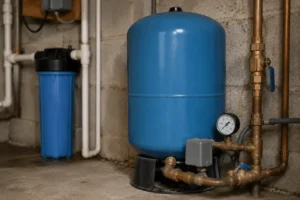
Two parts can drag your pressure down here. The pressure switch and the pump itself.
The switch is the cheap one. It tells the pump when to turn on and off. After years of cycling, the contacts pit and corrode, and the pump either runs constantly or shuts off too early. The pressure switch is often one of the simpler well system components to repair or replace. However, if left unchecked, switch problems can place additional strain on the pump and lead to more serious system issues over time.
The pump is the expensive one. In many cases, homeowners ignore gradual pressure loss until the pump begins failing. Worn pump components can reduce water pressure over time and eventually lead to a full pump replacement if left unresolved. Catching pressure issues early can often prevent more extensive well system repairs.
That’s the part nobody tells you. A worn switch becomes a burned-out pump. The longer you wait, the bigger the bill gets. Watch for the early signs of pump failure before it gets that far.
Because well systems vary, a professional inspection is often the best way to identify the exact cause.
This one gets overlooked constantly.
If you’ve got a sediment filter, an iron filter, or a softener feeding your house, a clogged cartridge can choke off your flow before water ever reaches the tap. Out here in the Willamette Valley, iron and sediment are common in well water, and filters can pack up faster than people expect.
The fix? Sometimes, a 10-minute cartridge swap. Sometimes a filter sizing issue that needs reworking. If it’s been more than six months since you changed a cartridge, that’s your first move.
This last one is rarer, but it’s real. Especially during dry Oregon summers.
A well that can’t recover water as fast as your household uses it will cause pressure drops during peak times. Long showers and dishwasher cycles run together, and the pressure tank empties faster than the well refills it. You can’t always fix the well itself. But you can fix how water gets delivered to the house.
A constant-pressure system with a variable speed drive is the most common solution. It paces the pump to match demand instead of slamming on full blast. The benefits of installing a VFD go beyond pressure, too. Pumps last longer. Energy bills drop.
A sudden drop in well water pressure may be caused by a failing pressure tank, clogged filter, pump issue, plumbing leak, or a low-yield well.
Yes. Sediment, iron, or water softener filters can restrict water flow and reduce pressure throughout the house.
Common signs include short-cycling, fluctuating pressure, noisy pump activity, or pressure dropping quickly when water is used.
Sometimes. Worn pump components can gradually reduce water pressure, especially in older systems.
Yes. Variable speed drives help maintain more consistent pressure by adjusting pump speed based on household demand.
Run the outside-faucet test. Check your filters. Listen for short-cycling on the pressure tank.
If your well system is struggling with low water pressure, don’t wait for the problem to get worse. The team at 5E Pump and Well Service can inspect your system, identify the cause, and recommend the right solution to restore reliable water pressure to your home.
If the well system is the issue, don’t keep babying it. Remember, a switch becomes a pump. Give us a call, and we’ll figure out what’s actually going on, usually the same day.


